Historic City · Gyeongbuk
Gyeongju guide: royal tombs, Donggung and Wolji, and Bulguksa routes
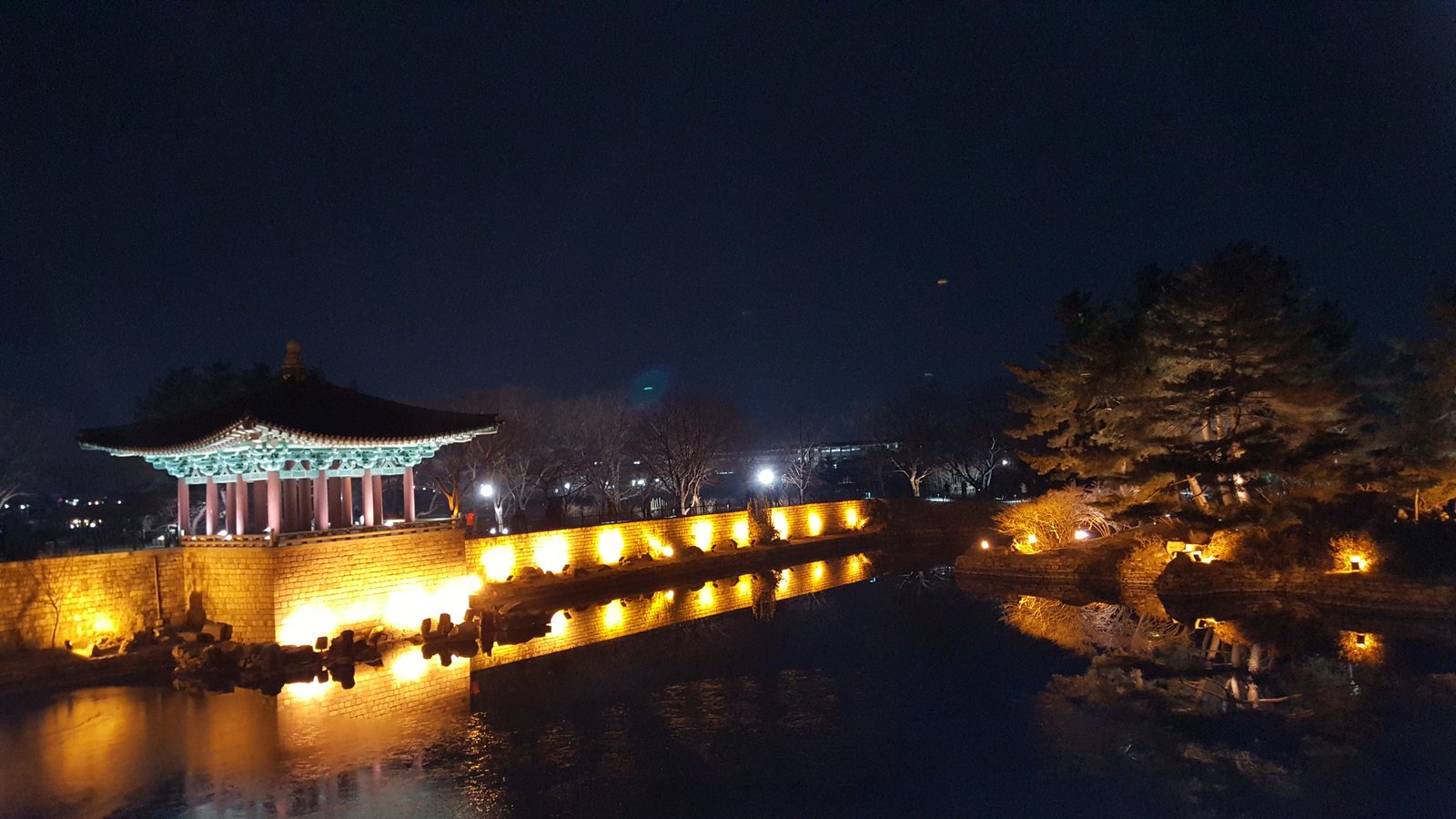

Gyeongju combines royal tombs, Cheomseongdae, a national museum and Donggung–Wolji in one city, with Bulguksa and Seokguram farther out. Start by deciding whether you can stay after dark: an evening pond visit and a return train need different timing from a daytime walk through the historic core. The 2026 Heritage Night dates listed by the city were September 18–20; that festival has ended as of this September 25 update.
Plan an ordinary evening, not a festival visit
The city listed Heritage Night for September 18–20, 2026, 18:00–23:00 around Woljeonggyo, Gyochon, Cheomseongdae, Gyerim and the fortress area. Those festival hours are not the normal opening hours of every attraction. For a later visit, check the actual entry deadline at Donggung–Wolji, reserve the return train, and allow a separate transfer back to Gyeongju Station. Do not assume the festival programme is still running.
What Gyeongju is: a museum without walls
Plan central Gyeongju and the Tohamsan area as separate parts of your itinerary. Walk among the tombs at Daereungwon; the separately ticketed interior of Cheonmachong uses reconstructed displays to explain the burial and its finds. Original objects, including the gold crown, belong to Gyeongju National Museum, so check its current displays if a specific object matters to you. In the city, Cheomseongdae is a Silla-period astronomical observatory. Donggung and Wolji, formerly also known as Anapji, preserves the site of a palace pond. Put it near the end of a central walk if you want night views, allowing for weather and closing time. In the Tohamsan area, Bulguksa and Seokguram form a single UNESCO World Heritage property. To see Bulguksa's Seokgatap and Dabotap pagodas and Seokguram's principal Buddha, plan each site's visiting hours and the journey between them separately.
The day-and-night plan: tombs, temple, pond
Our suggestion is to choose Daereungwon, Cheomseongdae or the museum by day, then Donggung–Wolji in the evening. Fit Hwangnidan-gil meals and hanbok rental around return deadlines. Bulguksa and Seokguram need a separate time budget. Even when using bus 10 or 11 to Bulguksa, Seokguram requires another journey and a walk; do not treat both as 20–30 minutes from town followed by a short stroll. Check current departures, connections and the last return service. Yangdong Village to the north is a separate half-day option, not a required extra in the same day.
Stops to choose for your route
Roughly in the order a visitor strings them, old core first, then the mountain. Korean names to match the signs.
- Daereungwon & Cheonmachong — Separate the tomb-park walk from the paid interior exhibition at Cheonmachong. Its reconstructed display explains the finds; original excavated objects, including the gold crown, belong to Gyeongju National Museum. Check the museum's current display before planning to see a specific original.
- Cheomseongdae (첨성대) — the 7th-century stone observatory, East Asia's oldest; lit at night, free to view, the symbol of the city.
- Donggung and Wolji (동궁과 월지) — the palace pond, formerly Anapji; come at dusk for the lit pavilions doubled in the water — Gyeongju's photograph.
- Hwangnidan-gil (황리단길) — the old-town street of cafés, craft shops and hanbok rentals beside the tombs; where the day begins and ends.
- Gyeongju National Museum (국립경주박물관) — free; the Silla gold, the Emile Bell (the great bronze bell of King Seongdeok), and the finds from the tombs.
- Bulguksa (불국사) — the 8th-century UNESCO temple on Tohamsan, with the Dabotap and Seokgatap stone pagodas; bus 10 or 11 from town.
- Seokguram — the granite grotto on Tohamsan, jointly inscribed with Bulguksa as World Heritage. Check travel from the temple and the grotto’s admission rules separately; sunrise or particular lighting is not guaranteed.
- Woljeonggyo Bridge (월정교) — the reconstructed Silla covered wooden bridge over the river, lit and reflected at night, a short walk from the core.
- Gyochon Hanok Village — locate the Choi family residence and Gyodong Beopju separately in the riverside village. Gyodong Beopju and Gyeongju Beopju are different names/products; check opening, tasting and purchase conditions.
- Yangdong Village (양동마을) — the UNESCO clan village of tiled and thatched Joseon houses north of the city; a half-day of its own.
Open Gyeongju on Naver Map (Korea's default map app — Google Maps is unreliable for walking and bus directions here).
Getting there from Seoul, and when
| Getting there from Seoul | KTX from Seoul Station to Gyeongju Station (formerly Singyeongju), about 2 hours; the station is outside the city, so take a local bus (about 30 minutes) or taxi into the historic core. SRT runs from Suseo. Intercity buses from Seoul's Express Bus Terminal take about 3.5–4 hours. Once there, the old core is walkable; buses 10 and 11 loop the main sights and reach Bulguksa. |
|---|---|
| Hours & tickets | Daereungwon park is free; entering Cheonmachong inside is separately ticketed. City-listed individual prices for Cheonmachong and Donggung–Wolji are each ₩3,000 adult (19–64), ₩2,000 youth (13–18) and ₩1,000 child (7–12). Cheomseongdae is free; the National Museum is free except charged special exhibitions. The city directs visitors to each temple for Bulguksa and Seokguram conditions; confirm with the temple instead of assuming both charge admission. Check each site’s last entry separately. |
| Best time | Heritage Night on 18–20 September has ended. Plan later evening visits around each attraction’s last entry and your return journey via Gyeongju Station. |
| Pair with | A second day at Yangdong Village (UNESCO Joseon village) or the Bomun resort lake; or continue to Busan, about an hour further south by train, for the coast. |
Choose the return train first, then fit Donggung–Wolji's admission deadline and the station transfer around it. If time is tight, separate the central heritage walk from the Tohamsan temples rather than rushing between them.
Check before you pay
Questions for planning this visit, not allegations against any business.
- If staying overnight, save the total including taxes and extra guests, latest check-in, no-show rules and cancellation deadline. If delayed, send your arrival time and obtain written confirmation that the room will be held. Sending a message is not acceptance.
- Secure the correct departure station and return service. For private transfers, record whether the quote is one-way or round-trip, passenger count, waiting charges and extra stops.
Show this Korean message to staff
도착이 늦어집니다. 오늘 밤 __시까지 객실을 유지할 수 있나요? 답변을 메시지로 부탁드립니다.
I will arrive late. Can you hold my room until __ tonight? Please reply in writing.
Unexpected charges or a cancelled booking? Free help guide →
Editorial prevention advice added: · Official help channels and sources
Map
Loading the map connects to NAVER. You can also use the external map link below.
Open in Naver Map Check your route and departure time in the map service before travelling.
Quick answers
How do I get to Gyeongju from Seoul?
The fastest way is the KTX from Seoul Station to Gyeongju Station (formerly Singyeongju), about 2 hours; the SRT runs from Suseo. The station is outside the city, so take a local bus (about 30 minutes) or a taxi into the historic core. Intercity buses from the Express Bus Terminal take about 3.5–4 hours.
What are the must-see sights in Gyeongju?
Prioritise Daereungwon park and separately ticketed Cheonmachong, Cheomseongdae, Donggung–Wolji and the National Museum. Bulguksa and Seokguram are two monuments jointly inscribed as one UNESCO World Heritage property. Add food or a café on Hwangnidan-gil, allowing separately for travel between the mountain and town.
Is one day enough for Gyeongju?
For one day, choose a few central sights and plan around Donggung–Wolji’s last admission. Bulguksa and Seokguram need separate transfers, so our editorial suggestion is to split the trip over two days. Adding Yangdong Village requires another transport and time calculation; it is not automatically included in a manageable two-day route.
When is the Gyeongju Heritage Night festival?
The city listed Heritage Night for September 18–20, 2026, 18:00–23:00 around Woljeonggyo, Gyochon, Cheomseongdae, Gyerim and the fortress area. Those festival hours are not the normal opening hours of every attraction. For a later visit, check the actual entry deadline at Donggung–Wolji, reserve the return train, and allow a separate transfer back to Gyeongju Station. Do not assume the festival programme is still running.
When is the best time to visit Gyeongju?
For blossom or autumn colour, check recent photographs, weather and access notices near your date. Neither a fixed peak week nor quieter weekdays is guaranteed. Plan Donggung–Wolji around last admission and your return trip; do not expect a guaranteed shaft of morning sunlight on the Seokguram Buddha.
Do I need tickets for the Gyeongju sights?
Daereungwon park is free; entering Cheonmachong inside is separately ticketed. City-listed individual prices for Cheonmachong and Donggung–Wolji are each ₩3,000 adult (19–64), ₩2,000 youth (13–18) and ₩1,000 child (7–12). Cheomseongdae is free; the National Museum is free except charged special exhibitions. The city directs visitors to each temple for Bulguksa and Seokguram conditions; confirm with the temple instead of assuming both charge admission. Check each site’s last entry separately.
Sources & data: VisitKorea · Gyeongju · UNESCO · Gyeongju Historic Areas · Gyeongju City Tourism · Gyeongju · admission fees · Gyeongju Heritage Night · 2026-09-18–20, 18:00–23:00 (ended) · Gyeongju · museum collections · UNESCO · Seokguram Grotto and Bulguksa Temple
Schedules and prices can change; use the linked official notices for your travel date. Route choices and time allowances are editorial suggestions.
A palace and a neighbourhood—in what order?
Choose one must-see, check its closure days and booking conditions for your date, then add a nearby meal and a rest stop. Build the day out from your accommodation.
A PAID SERVICE BY MEETORY
Turn your wish list into a day that works.
A PDF built around your accommodation, dates and preferred places: routes, meal options and booking guidance, maps and useful Korean phrases.
₩19,900Personalized guide / one language edition
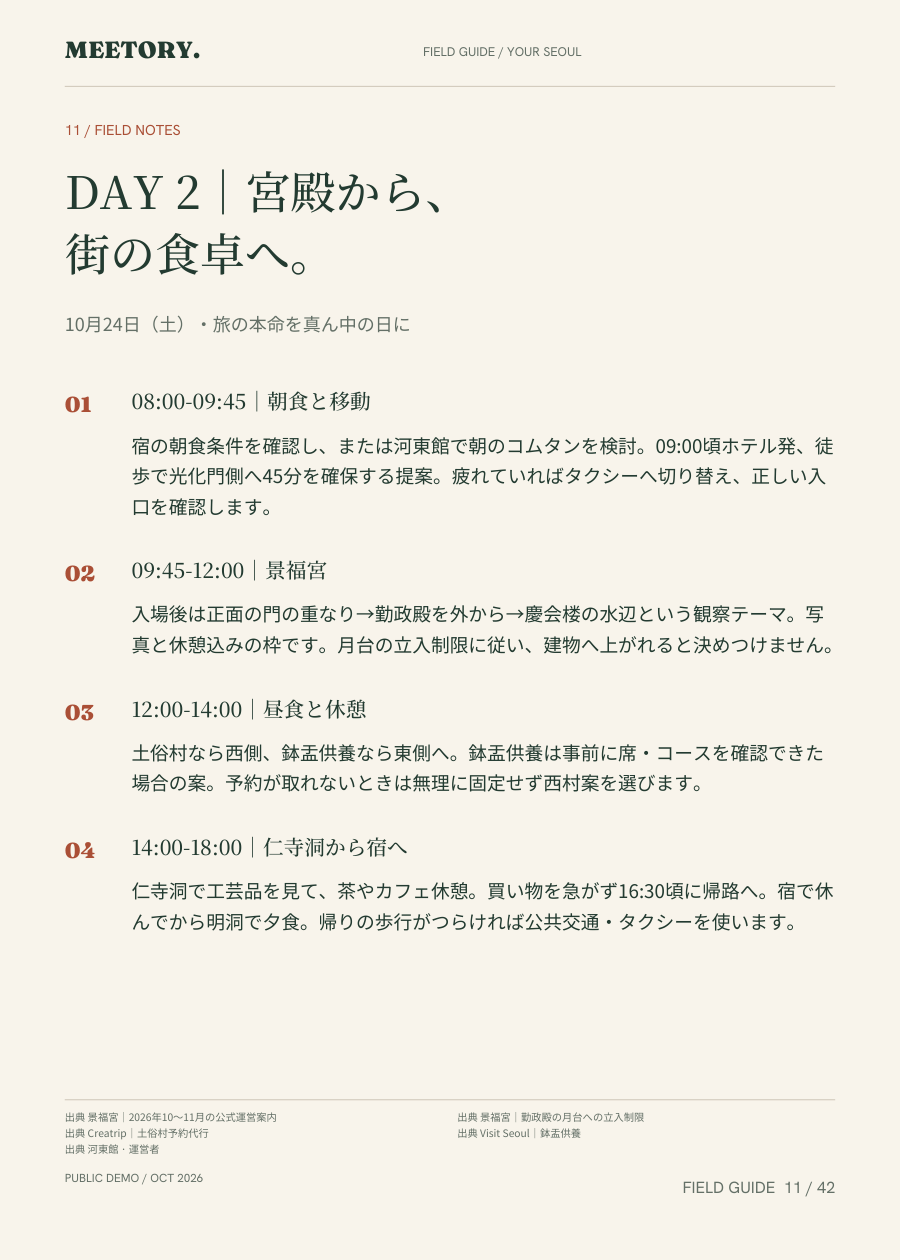 An actual page from the Japanese demo
The preview is a Japanese demo of a fictional Seoul trip. Ask about delivery in Japanese, English or Traditional Chinese. Availability, scope, delivery, revisions and the final total are confirmed before ordering. Tickets, accommodation and reservation services are excluded.