Temple · Busan Coast
Haedong Yonggungsa: why Korea's seaside temple is suddenly all over Korean search
「해동용궁사」
+1,000% · 20K+ · past 7 days
Source: Google Trends (KR) & NAVER DataLab, relative search volume
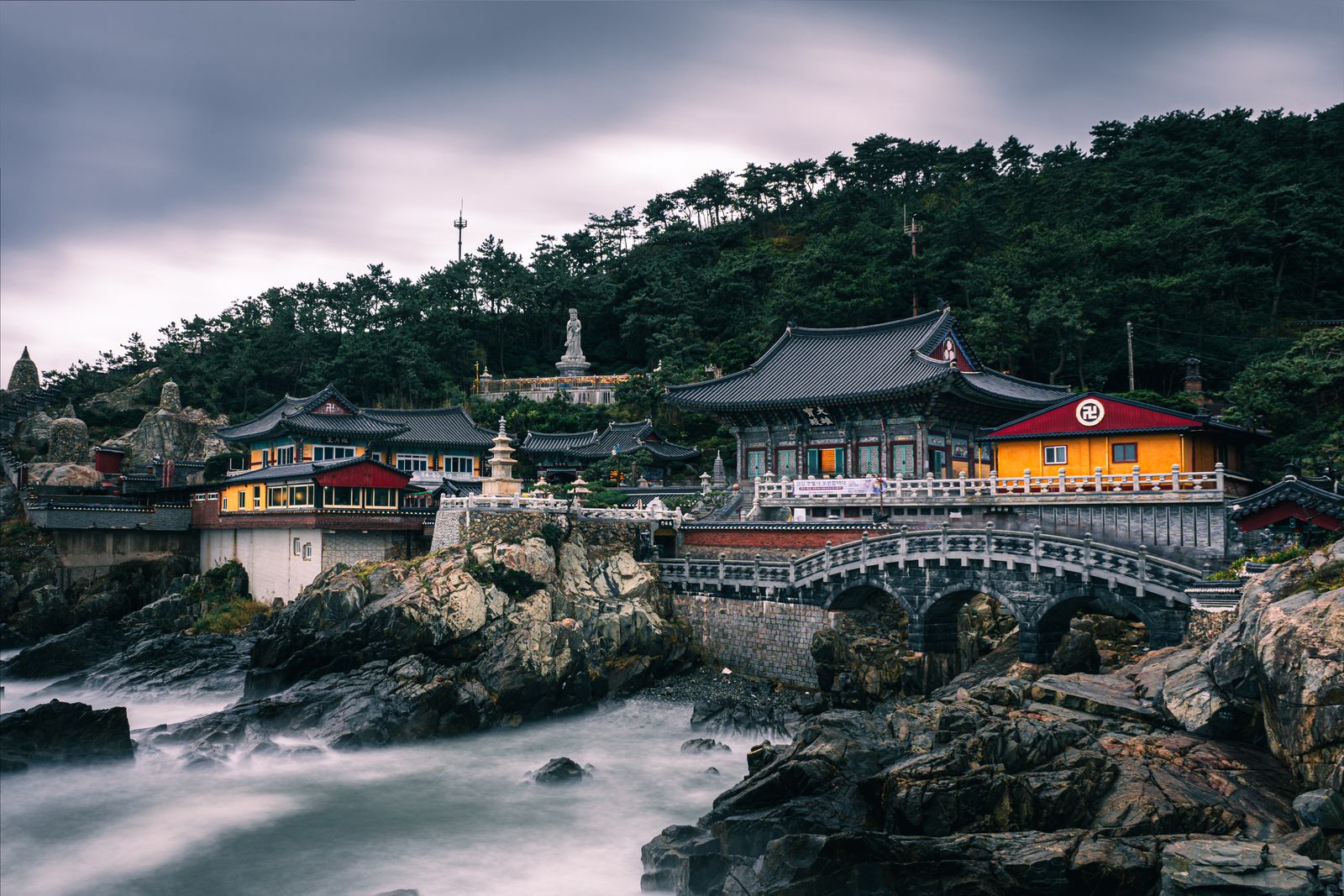
Most Korean temples hide deep in the mountains. Haedong Yonggungsa (해동용궁사) does the opposite: it stands on a cliff of black rock in Gijang, on Busan's northeastern coast, so close to the water that spray from breaking waves reaches the stone lanterns. This week it jumped into Korea's top trending searches with 20K+ queries — and the reason is more interesting than a pretty sunrise.
Why is it trending right now?
Two currents collided. First, late summer is peak season: NAVER DataLab shows searches for the temple climbing through July and August as Busan filled with holiday travelers. Second — the spark — on August 30 a post went viral on Threads: a visitor said she was stopped from entering the main hall because of her visible tattoos. Korean news outlets from SBS to Seoul Shinmun picked it up within a day, and the country started debating where religious etiquette ends and discrimination begins. Whatever your view, the debate put the temple on every screen in Korea.
For travelers there is a practical takeaway, and we cover it below in the etiquette section — because this is exactly the kind of thing a guidebook written last year will not tell you.
650 years above the waves
The temple was founded in 1376, during the Goryeo dynasty, by the famous monk Naong Hyegeun, and was originally called Bomun-sa. Destroyed during the Japanese invasions of the 1590s, it was rebuilt in the 1930s and took its current name — "Korean Dragon Palace Temple" — in the 1970s, after a vision of the sea god's underwater palace. It is regarded as one of Korea's key sacred sites of Gwanseeum-bosal (the Bodhisattva of Compassion), who in Korean tradition dwells by the sea.
What makes it unforgettable is the approach. You pass a tunnel of twelve zodiac animal statues, then descend 108 stone steps — one for each of the 108 worldly desires in Buddhist teaching — and the temple suddenly opens below you, framed between cliff and ocean. Come before dawn and you will share the steps with locals waiting for sunrise; the temple is one of Korea's most famous first-sunrise spots on New Year's morning.
What to see
- Daeungbojeon (main hall) — rebuilt in vivid dancheong colors, facing the sea.
- Haesu Gwaneum Daebul — a 10m white statue of the sea-facing Bodhisattva of Compassion, the temple's icon.
- 108 steps & Ilchul-am (Sunrise Rock) — the classic photo spot; go at first light.
- Golden pigs and wish statues — rub the belly for luck; locals genuinely do.
- Yongmun stone bridge — where cliff, waves and temple line up in one frame.
Visitor information
| Address | 86 Yonggung-gil, Gijang-eup, Gijang-gun, Busan |
|---|---|
| Hours | Roughly sunrise to sunset (early morning opening for sunrise visits; hours vary by season) |
| Admission | Free (parking is paid) |
| Best time | Sunrise, or weekday mornings before tour buses arrive around 10am |
| Time needed | 1–1.5 hours on site |
Etiquette: read this before you go
This week's controversy makes it worth saying clearly: the temple is an active place of worship, not a photo set. Based on current reporting and the temple's own guidance:
- Dress modestly to enter halls — cover shoulders and knees; heavily exposed tattoos may be asked to be covered. Carrying a light shawl or long-sleeve layer solves both.
- Take photos of buildings and sea views freely, but not of people praying inside halls.
- Keep voices low inside hall areas; remove shoes where indicated.
Eat like a local: Yeonhwa-ri haenyeo village
Five minutes down the coast is Yeonhwa-ri, a small port where haenyeo — Korea's famous free-diving women — sell what they caught that morning. This is the correct lunch after the temple. Spots that locals actually queue for (all in Yeonhwa-ri, per NAVER local listings):
- Jang's Haenyeo House (장씨해녀집) — abalone porridge and raw seafood platters from diver hauls.
- Gohyang Yeonhwa (고향연화) — homestyle Korean seafood set meals.
- Haepung Gamasot (해풍가마솥) — cauldron-cooked Korean comfort food.
- Aewol Bread Factory Gijang (애월빵공장) — a huge seaside bakery-café for coffee with an ocean view.
Make it a day: the Osiria loop
The temple sits inside the Osiria Tourist Complex, which means you can chain it with Lotte World Adventure Busan (theme park), Ananti Cove (seaside shopping and cafés), the National Science Museum, and the coastal walk to Orangdae Park. Temple at sunrise, haenyeo lunch, café afternoon — that is a perfect Busan day trip without entering the city center.
Getting there
| Metro + walk | Donghae Line to OSIRIA Station, then 20–25 min walk or short taxi (~basic fare) |
|---|---|
| Bus | City buses 100, 139, 181 toward Yonggungsa/Gijang from Haeundae area |
| From Haeundae | Taxi ~20 min; the easiest option for sunrise visits |
Sources & data: Google Trends KR (7-day trending searches, ~20K+, Sep 1, 2026), NAVER DataLab weekly search index (Jun–Sep 2026), Korean news reports dated Aug 30–Sep 1, 2026, NAVER Local business listings for the Yeonhwa-ri area.
Opening hours, prices and policies change often — always check official channels before visiting. Search figures are relative values provided by Google Trends and NAVER DataLab.