Road Trip · Icon of Korea
The Gyeongbu Expressway: Korea's most-searched road, and the best way to see the whole country
「경부고속도로」
+1,000% · 10K+ · past 7 days
Source: Google Trends (KR) & NAVER DataLab, relative search volume
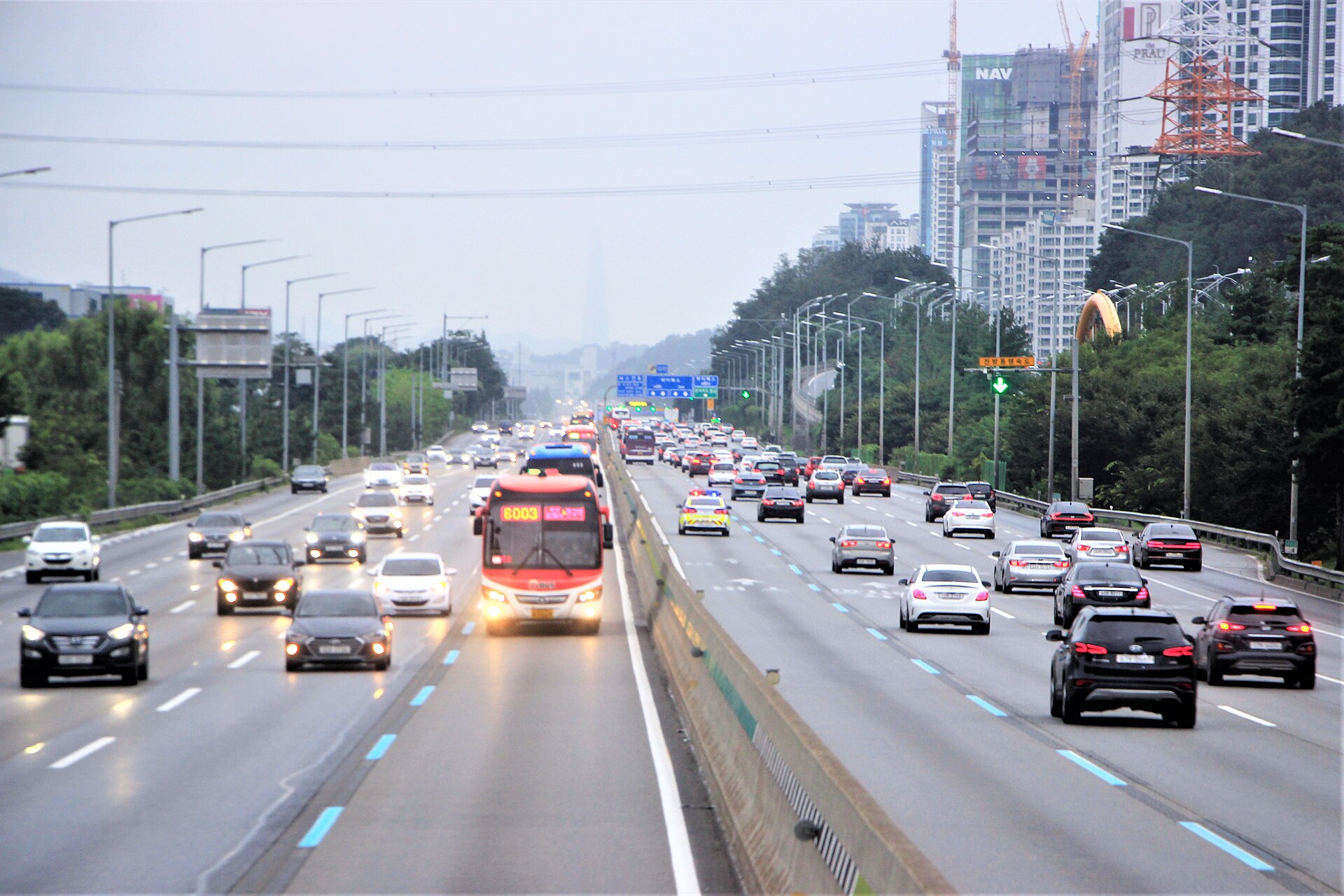

Every country has one road that explains it. For Korea it is the Gyeongbu Expressway (경부고속도로): 416 kilometers of asphalt connecting Seoul and Busan (416 km as originally built in 1970), the spine along which modern Korea was built. It sits permanently near the top of Korean place searches — this week it spiked again to 10K+ queries, driven by accident news coverage and the approach of the Chuseok holiday migration.
Why it keeps trending
Unlike a viral café, an expressway trends for practical reasons. Recent spikes track three things: traffic-heavy summer weekends, news coverage — including a fatal collision near Anseong reported on September 1 — and the countdown to Chuseok (Korean Thanksgiving), when tens of millions of Koreans drive to their hometowns and "경부고속도로 교통상황" (traffic conditions) becomes a national reflex search. When this keyword rises, Korea is on the move.
The road that built a country
Construction began in 1968 under a plan many experts called impossible; the full route opened on July 7, 1970, after just two and a half years. At the time, critics said a poor agricultural country did not need a four-lane highway. Instead, the road became the growth engine of the "Miracle on the Han River" — factories, ports and cities lined up along it, and today roughly seven in ten Koreans live within its corridor. For a visitor, driving it is a rolling museum of Korean modernization.
How the system works (visitor edition)
| Route | Seoul ↔ Busan, 416 km, roughly 4.5–5 hours nonstop |
|---|---|
| Tolls | Distance-based; Seoul–Busan around ₩20,000 for a passenger car. Rental cars usually include a Hi-Pass transponder — ask at pickup and use the blue Hi-Pass lanes |
| Speed limit | 100–110 km/h on most sections; enforcement cameras are frequent and average-speed sections exist |
| Live traffic | NAVER Map or Kakao Map apps (both have English interfaces); Korea Expressway Corp. operates a 24h info line (1588-2504) |
Rest stops are a destination
Korean expressway rest areas (휴게소, hyugeso) are a genuine cultural experience — food courts where regional specialties compete for drivers' loyalty. On the Gyeongbu line, classics include walnut cakes near Cheonan (the original hodu-gwaja region), Anseong's namesake soup stops, and udon-and-tteokbokki counters that Koreans rank in online tier lists. Budget 30 extra minutes per stop; you will want them.
A road-trip itinerary that works
- Day 1 — Seoul → Daejeon (2h): break at Cheonan for walnut cakes; Daejeon for Sungsimdang bakery, a national pilgrimage site.
- Day 2 — Daejeon → Gyeongju (2h): leave the expressway for Silla-dynasty tombs, Bulguksa Temple and a hanok-village night.
- Day 3 — Gyeongju → Busan (1h): arrive for sunset at Haeundae — and if you read our featured story, sunrise at Haedong Yonggungsa the next morning.
Sources & data: Google Trends KR (10K+ searches, past 7 days), NAVER DataLab weekly index (Jun–Sep 2026), Korean news reports from Aug–Sep 2026 including accident and infrastructure coverage.
Opening hours, prices and policies change often — always check official channels before visiting. Search figures are relative values provided by Google Trends and NAVER DataLab.